Sustainability Reporting vs. Sustainability Disclosure: What's the Difference?
Many people use the terms sustainability reporting and sustainability disclosure as if they mean the same thing. That's understandable, since both are about a company showing its sustainability work, but in practice they're two different things with different legal status.
.png&w=2048&q=75)
One is a legal requirement with clear conditions for which companies are covered. The other is a voluntary way of communicating sustainability work, with no mandatory template.
In this article we go through what separates sustainability reporting from sustainability disclosure, which rules govern the statutory requirement, and what a smaller company actually needs to care about. If you'd rather read about exactly which companies are covered by the CSRD and the new EU thresholds, we have a separate guide for that.
Two terms that often get mixed up
In short: sustainability reporting is the statutory term. It refers to the sustainability report that certain Swedish companies are legally required to prepare, with requirements coming from the Annual Accounts Act (ÅRL) and the EU's CSRD directive (1). Sustainability disclosure, on the other hand, is a broader, voluntary term for any kind of document in which a company accounts for its sustainability work, whether or not there's a legal requirement behind it.
A company can therefore have a statutory sustainability report and also call its broader communication material a sustainability disclosure. The two terms partly overlap, but they aren't the same thing, and the difference matters as soon as an auditor, an investor or a customer asks exactly what the company is obliged to show.
Sustainability reporting: the statutory requirement
Sustainability reporting refers specifically to the sustainability report regulated by law. So it's not up to the company to decide whether the report should exist. If the company meets the criteria, it's a requirement, in the same way as the annual report and other financial reporting.
Statutory sustainability reporting since 1 July 2024
The Swedish legislative changes implementing the CSRD entered into force on 1 July 2024 (4). Since that date, new, EU-harmonised rules apply to which Swedish companies must prepare a sustainability report and what the report must contain. Before then, older, lower Swedish thresholds applied (including net turnover of SEK 350 million), and these have now been replaced.
Which companies must prepare a sustainability report?
Under the Annual Accounts Act, larger companies and groups must prepare a sustainability report if they meet more than one of the following conditions in each of the last two financial years (1)(9):
- The average number of employees has exceeded 250
- The balance sheet total has exceeded SEK 280 million
- Net turnover has exceeded SEK 550 million
Companies whose securities are admitted to trading on a regulated market are covered in some cases regardless of size. These are the criteria for Swedish "large companies" under current law. If you want the full picture, including the new, common EU thresholds on their way through the Omnibus package, we've gathered everything in our guide on which companies must report under the CSRD.
Worth mentioning: the EU's Omnibus package, which simplifies the CSRD, was finally approved by the Council in February 2026 and entered into force in March 2026 (2). It affects which companies will be covered by the EU's common thresholds in future, but it doesn't in itself change the Swedish ÅRL criteria above until they've been rewritten in Swedish law. If you want to understand exactly how your company is affected by the new thresholds, the page on which companies are covered is the right place to read on.
What must the sustainability report contain?
The sustainability report must contain the information needed to understand the company's development, position and results and the impact of its activities, including information on the environment, personnel, social matters, respect for human rights and anti-corruption (9). For the largest companies, it must also meet more detailed requirements under the ESRS (European Sustainability Reporting Standards), the standards developed by the European Commission to make sustainability information comparable between companies and countries.
The idea is that sustainability information should be as readable and reliable as financial information: relevant, consistent and open to scrutiny, not just a few nice words from the communications department tucked into the annual report.
Where in the annual report do you find it?
The sustainability report is placed either as its own section in the management report, or as a separate report that the management report refers to (1)(9). Both options are allowed by law. The company chooses whichever suits it best, as long as the report is clearly findable from the annual report.
The auditor's review of the sustainability report
An important difference from voluntary sustainability disclosure is that the statutory sustainability report must be reviewed by an auditor. In Sweden, the review follows FAR's standard RevR 19, "Standard for limited assurance review of statutory sustainability reports" (3). At present it's a limited review (also known as "limited assurance"), not a full audit. An earlier proposal to tighten the requirement to a full audit ("reasonable assurance") was removed in the Omnibus package, which means the lower level of assurance continues to apply (2).
The auditor checks, among other things, that the report has been prepared, that it covers the areas the law requires, and that the information doesn't clearly conflict with other parts of the annual report.
Sustainability disclosure: the voluntary document
Sustainability disclosure is a broader term. It covers all voluntary material in which a company tells the story of its sustainability work, whether or not the company is required to prepare a statutory sustainability report.
Common frameworks for voluntary sustainability disclosure
Many companies that want to account for their sustainability work voluntarily use established international frameworks. The most common globally is the GRI (Global Reporting Initiative), which gives companies a common structure for what sustainability information to produce and how to present it (7). Other companies start from the GHG Protocol when calculating their emissions, since it's the standard most calculation tools, including GoClimate's, are built on (8).
The difference from the statutory report is that none of this is a requirement. The company chooses the scope, framework and level of detail, and there's no requirement for an auditor to review the content.
The disclosure can be called almost anything
In practice, a voluntary sustainability disclosure can go by many names: sustainability report, environmental report, climate report, ESG report, or simply "our sustainability work" on the website. The name doesn't always tell you whether the content is statutory or not. That's why the terms so often get mixed up, and why it's worth asking which type of document you're actually talking about.
How do the two terms relate?
The two terms aren't opposites, but rather two circles that partly overlap. A larger company covered by the legal requirement has a sustainability report (the statutory part) and can also call its broader material a sustainability disclosure. A smaller company that isn't covered by the requirement can still choose to produce a voluntary sustainability disclosure, without any sustainability report in the legal sense existing.
It's also common for companies that are growing into the legal requirement to start with a voluntary sustainability disclosure to practise collecting and presenting sustainability data before the requirements become legally binding for them.
What should a smaller company care about?
Most small and medium-sized companies in Sweden aren't currently covered by the legal requirement for sustainability reporting. But that doesn't mean sustainability is any less important to them.
Even without a legal requirement, many customers, banks and investors ask their suppliers and partners for sustainability information, especially if the supplier is part of the value chain of a larger company that is itself covered by the CSRD. This is increasingly true, as large companies need to collect data further down their supply chain for their own reporting.
There's also a clear business benefit. Sustainability information showing how the company handles risks and opportunities linked to climate and the environment can make it easier to manage financial risks and to attract sustainable investment (6). Many banks now factor sustainability data into their credit decisions, and more and more procurements require suppliers to be able to show some form of sustainability information.
VS (formerly VSME): the framework for small and medium-sized companies
To make it easier for smaller companies to meet this demand without having to build a report from scratch, EFRAG has developed VS, EU:s Voluntary Standard (formerly known as VSME) (5). VS is entirely voluntary, and the European Commission has recommended it as a standardised, proportionate way for smaller companies to answer sustainability questions from larger business partners, without having to meet the same level of detail as large listed companies (6).
VS comes in two modules: a basic module with the most commonly requested core data points, and a more comprehensive module for companies that want or need to go further, for example if a larger customer asks for more detailed information. Because VS is designed to be proportionate and not require the same resources as a full sustainability report, it's a natural first step for many smaller companies that want to start collecting sustainability data in a structured way.
How do you collect sustainability data in practice?
Whether the goal is a statutory sustainability report, a voluntary sustainability disclosure under EU Voluntary Standard (formerly VSME) or GRI, or simply an answer to a customer who's asking, it all starts with the same foundation: a calculation of the company's climate impact. Without a calculation, there's no data to report and no baseline to improve on over time.
Frequently asked questions about reporting and disclosure
Do all companies have to have a sustainability report?
No. Only companies and groups that meet the statutory thresholds, including average number of employees, balance sheet total and net turnover, are required to prepare a sustainability report (1)(9). Other companies can choose to produce a voluntary sustainability disclosure instead, but aren't obliged to.
Can sustainability disclosure replace sustainability reporting?
No, not for companies covered by the legal requirement. A voluntary sustainability disclosure doesn't meet the formal requirements for content, placement in the management report or the auditor's review that apply to the statutory sustainability report. Companies covered by the requirement therefore need to have both if they also want to communicate their broader sustainability work outside the statutory report.
What happens if a company doesn't prepare a sustainability report?
A company that's covered by the requirement but doesn't prepare a sustainability report risks the same kind of consequences as for other shortcomings in the annual report, since the sustainability report is part of the formal requirements for the annual report. We always recommend checking with your company's auditor about exactly what applies to your own company, as the details can vary depending on company form and group structure.
Summary: reporting vs. disclosure
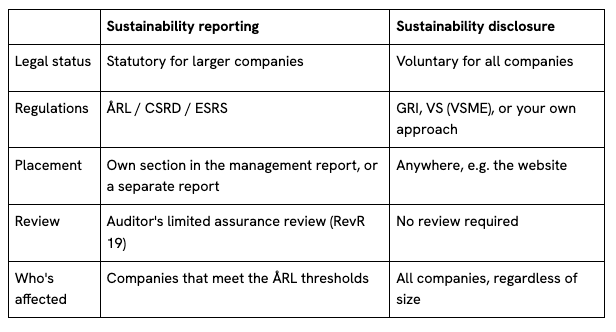
In short: sustainability reporting is the narrower, legally binding term. Sustainability disclosure is the broader, voluntary term that also includes the statutory report, but not the other way around.
Ready to take the first step?
Whether you're a large company with a legal requirement to report on sustainability, or a smaller company that wants to meet customers' and banks' expectations voluntarily, it all starts with a reliable calculation of your climate impact.
Sources
- FAR: Voluntary or statutory sustainability reporting
- Council of the EU: Council signs off simplification of sustainability reporting and due diligence requirements, 24 February 2026
- FAR Online: RevR 19, The auditor's limited assurance review of the statutory sustainability report
- Finansinspektionen: Sustainability reporting (NFRD/CSRD)
- EFRAG: Voluntary reporting standard for SMEs (VSME)
- European Commission: Commission presents voluntary sustainability reporting standard to ease burden on SMEs
- GRI: Global Reporting Initiative, Standards
- GHG Protocol
- EY: New rules for sustainability reporting, CSRD and the Annual Accounts Act
- FAR: Questions and answers about the CSRD
Want to go from knowledge to action?
See how GoClimate turns your accounting into a report you can act on.