Renewable and Recycled Materials and Their Climate Impact
To reduce emissions from products and supply chains, companies need to work smarter with the resources that already exist and those that can be regrown. Renewable and recycled materials represent two key paths forward — but they serve different purposes and are not interchangeable.
Material extraction and processing account for roughly half (about 50 percent) of global greenhouse gas emissions when both energy- and industry-related emissions are included [1]. This means material choices have a major impact on the climate — often more than transport or packaging design.
Here we go through what renewable and recycled actually mean in practice, how they differ, and which choices deliver the greatest climate benefit within textiles, paper, glass, and metal.
Why do material choices matter so much?
Globally, material extraction and processing account for roughly half of the world's greenhouse gas emissions when both energy- and industry-related emissions are included [1]. In many industries, the majority of emissions occur during raw material extraction and early production — stages that also affect land, water, biodiversity, and local ecosystems.
By choosing:
renewable materials – raw materials that nature can regrow
recycled materials – raw materials that have already been used and returned to the loop
…we can reduce the need for new extraction, lower energy use, protect the environment and ecosystems, and cut greenhouse gas emissions.
But "sustainable" is never just a material choice. It's also about quality, traceability, energy source, design, lifespan, and how much is produced — factors that together determine the actual impact on both climate and environment.
How does recycled material work?
Recycled material comes from waste: textiles, plastic, paper, glass, metal, or production offcuts. It's collected, sorted, and processed into new raw material — mechanically or chemically.
Core principle: we make something new out of something that already exists — reducing the need for virgin raw material.
Examples across material types
Textiles
rPET (recycled polyester) – often from PET bottles or industrial waste. Generally has a lower climate impact than virgin polyester [2].
Recycled cotton – reduces the need for water and land compared with virgin cotton, but the fibers become shorter.
Regenerated fibers that are recycled – for example viscose or lyocell in chemical systems.
Paper
Recycled paper generally requires less energy than production from new wood fiber and reduces the need for logging [4]. At the same time, fibers can only be recycled a limited number of times before new fiber must be added.
Glass
Glass can, in principle, be recycled infinitely without loss of quality. A higher share of cullet (recycled glass) reduces the energy needed in the melting process and thereby emissions [5].
Metal
Aluminum: Recycled aluminum requires up to 95 percent less energy than primary production from ore [6].
Steel: Production based on recycled material in electric arc furnaces can significantly cut emissions compared with traditional blast furnace production [7].
Recycled material often delivers a direct climate benefit because it reduces the energy needed in production.
What are renewable materials?
Renewable materials come from resources that nature can regrow within a reasonable time.
Common categories include:
Plant-based materials: cotton, linen, hemp, wood fiber (paper and cardboard)
Wood-based regenerated fibers: lyocell/TENCEL™, modal, viscose
Animal-based fibers: wool, alpaca, silk
Core principle: the raw material grows or is produced anew — provided that farming, forestry, or animal husbandry is carried out responsibly.
But renewable does not automatically mean low climate impact. Cotton cultivation can be water-intensive [3]. Forestry can affect carbon storage and biodiversity depending on how it's managed [1]. Animal production can give rise to methane emissions.
The difference between recycled and renewable — in practice
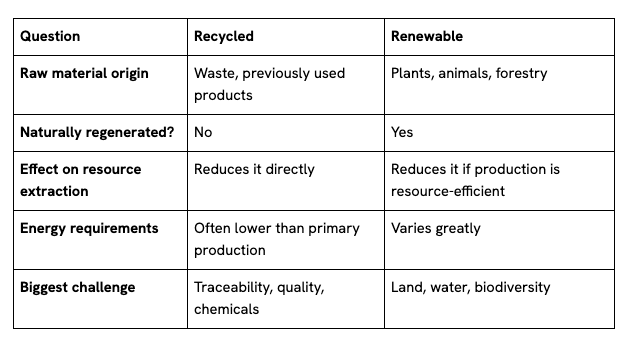
In short: they solve different problems — and both are needed.
Renewable materials: when are they the best choice?
Renewable materials are often a good choice when:
production is resource-efficient
water and land use are controlled
the energy used in production is renewable
the product has a long lifespan
Linen and hemp can be grown with relatively low water and chemical input. Wood fiber can be efficient in regions with sustainable forestry. Wool can have a long lifespan and high functionality.
But even renewable materials can generate significant greenhouse gas emissions if production is intensive or powered by fossil energy.
Recycled materials: circularity in practice
Recycled materials are especially effective in material categories with a high climate cost in primary production.
Aluminum: up to 95 percent lower energy use when recycled [6].
Glass: reduced energy requirement as the share of cullet increases [5].
Polyester: lower climate impact compared with virgin production [2].
Paper: reduced energy use compared with new fiber [4].
This is where the link between energy and climate becomes clear. If the recycling process is also powered by renewable electricity, emissions are cut even further.
Benefits of combining renewable and recycled
Working with both delivers several benefits:
Less need for new extraction — Pressure on land, forests, ore, and fossil raw material is reduced.
Lower greenhouse gas emissions — Especially for materials like aluminum, steel, and plastic, recycled content can drastically cut energy requirements [6][7].
Better resource management — Materials stay in circulation longer, which is central to a circular economy [1].
Lower waste levels — Recycling reduces the amount of waste that would otherwise go to incineration or landfill.
So what's actually most sustainable?
The most sustainable option is almost always the one that's used the longest. Material matters — but lifespan, quality, repair, and responsible consumption affect the climate even more.
Therefore, prioritize:
Use what already exists.
Choose recycled where the quality is sufficient.
Choose renewable materials from responsible production systems.
Ensure production runs on renewable energy.
Avoid overproduction and overconsumption.
Pitfalls to avoid:
Assuming "renewable" is always climate-smart.
Believing recycled automatically solves every problem.
Ignoring the type of energy used in production.
Focusing on material while ignoring volume and lifespan.
Using oversimplified messaging that risks greenwashing.
No material can compensate for overproduction. The greatest climate benefit comes when material choices are combined with efficient production, reasonable volumes, and long lifespans.
How companies can get started
Conduct a material inventory — which raw materials have the greatest climate impact?
Prioritize the materials where emissions are highest in percentage terms.
Work closely with the largest suppliers to jointly identify more sustainable alternatives.
Increase the share of recycled material where it delivers a clear effect.
Ensure responsible production of renewable raw materials.
Require renewable energy in production.
Contribute directly by setting requirements and demanding more sustainable materials from suppliers.
Work on design for repair and recyclability.
Every step counts. Sustainable material transition isn't about perfection — it's about systematically reducing greenhouse gas emissions over time.
Sources
- UNEP / International Resource Panel (2019). Global Resources Outlook 2019.
- European Environment Agency (2022). Textiles and the environment.
- WWF (2021). Cotton and Water.
- International Energy Agency (2022). Pulp and Paper.
- FEVE (2022). Glass Recycling – Facts & Figures.
- International Aluminium Institute.
- IEA (2023). Steel and aluminium.
Recommended reading
Want to go from knowledge to action?
See how GoClimate turns your accounting into a report you can act on.