What Is an LCA (Life Cycle Assessment) – and Why Is It So Important for Sustainability Work?
How much impact does a product, service, or process really have on the climate and the environment? An LCA – Life Cycle Assessment – helps you find out exactly that (1,4,5).
An LCA provides a full picture of a product throughout its entire life cycle – from raw material extraction to end-of-life – and is the foundation of credible climate strategies, product comparisons, and environmental labels.
What Does LCA Mean?
An LCA (Life Cycle Assessment) is a science-based method for calculating and analysing the environmental impacts of a product or service throughout its entire life cycle (1,3). It involves mapping how much energy and resources are used, which materials are included, and what emissions occur at each stage – to air, soil, and water.
An LCA typically considers several phases of the life cycle:
- Raw material extraction – where the materials come from and the environmental impact of extraction.
- Manufacturing – how much energy and resources are needed to create the product.
- Transportation – how materials and finished products are transported.
- Use phase – how much energy, water, or other resources are required when the product is used.
- End-of-life, recycling, or incineration – what happens when the product is no longer used, and whether materials can be recovered.
Want to calculate the footprint of your own products (PCF)? GoClimate guides you through calculating climate emissions per product – try now!
The aim is to avoid shifting the problem. A product should not appear sustainable in one stage – such as during use – while causing significant harm during manufacturing or relying on unsustainable materials. Seeing the full picture is essential for making choices that benefit both the climate and the environment (4).
An LCA can also be used to compare different products or solutions and identify where the greatest environmental impact occurs (2). This helps companies, designers, and decision-makers reduce resource use, switch to more sustainable materials, and develop products with lower impacts throughout their entire life cycles.
In short: an LCA helps you make solid, evidence-based decisions and is an essential tool for anyone wanting to understand and reduce their environmental impact in a meaningful way.
What Is Included in an LCA?
A full LCA covers multiple environmental aspects, not just carbon emissions (1,5). The purpose is to provide a holistic view of how a product, service, or process affects the environment across its entire life cycle – from raw materials to end-of-life. It considers both direct and indirect impacts and highlights where the most significant effects occur.
Common environmental aspects included in an LCA:
- Climate impact (CO₂e) – emissions contributing to global warming.
- Energy use – total energy demand and the types of energy used.
- Water use (WUE) – water consumed during production, use, and disposal.
- Resource use and waste – how natural resources are used, waste generated, and material recovery potential.
- Acidification, eutrophication, land impact – effects on ecosystems, soil quality, and biodiversity.
An LCA must be based on clear system boundaries and high-quality data to ensure reliable results (1). By using a consistent methodology, different products or solutions can be compared fairly.
The method typically follows ISO 14040 and ISO 14044 standards (1,3), ensuring compliance with international guidelines. This makes results comparable, credible, and usable for decisions in areas such as product development and environmental labelling.
What Is the Difference Between LCA, EPD, and PCF?
Many companies – especially SMEs facing increasing sustainability demands from customers and larger actors – wonder what separates LCA, EPD, and PCF (2). All three are used in sustainability work but serve different purposes.
A simple overview:
LCA (Life Cycle Assessment)
A full life cycle analysis showing a product’s total environmental impact from raw materials to end-of-life (1). It follows ISO 14040/14044 and forms the basis for both EPD and PCF.
PCF (Product Carbon Footprint)
A narrower assessment focusing only on climate impact (CO₂e) (2). Large companies often request PCF data from suppliers to meet CSRD/ESRS requirements for activity-based emissions.
EPD (Environmental Product Declaration)
A third-party verified environmental declaration based on an LCA (2). It follows ISO 14025 and EN 15804, providing comparable environmental data often used in procurement, construction, and product comparisons.
Why Does This Matter – Especially for SMEs?
Companies subject to CSRD and ESRS must report detailed emissions and increasingly rely on product-level data from suppliers (2). This means that even businesses without legal reporting obligations face rising expectations to deliver LCA or PCF data, or demonstrate environmental performance through an EPD.
For SMEs, this means:
- Customers may request PCF or LCA data
- Tenders may require EPDs
- Banks and investors assess climate risks based on product impacts
- Transparency becomes a competitive advantage
Why Should Companies Conduct an LCA?
An LCA provides insights that support decision-making – not only for sustainability reporting but also for business strategy and product development (2).
Key benefits:
- Identify where the impact occurs
Understand which life cycle stages drive the highest emissions – manufacturing, transport, use, or end-of-life. - Prioritise the right actions
Instead of guessing, target efforts where they have the greatest effect. - Strengthen credibility
Customers, investors, and procurement processes increasingly require LCA data or EPDs (2). - Comply with regulations
Companies under CSRD/ESRS must report detailed, activity-based emissions – pushing suppliers to provide LCA/PCF data.
Even SMEs feel this pressure through customer and investor expectations (2). - Develop circular solutions
LCAs often show that lifespan, recyclability, and materials matter significantly – guiding circular product design (2).
LCA in Practice: Example
Imagine your company produces T-shirts. An LCA might show:
- 70% of climate impact comes from cotton cultivation and processing
- 20% from transport and manufacturing
- 10% from the use phase (washing, drying, ironing)
This highlights where sustainability efforts should focus: material choice (e.g., organic or recycled cotton), resource-efficient production, and customer guidance on garment care (2).
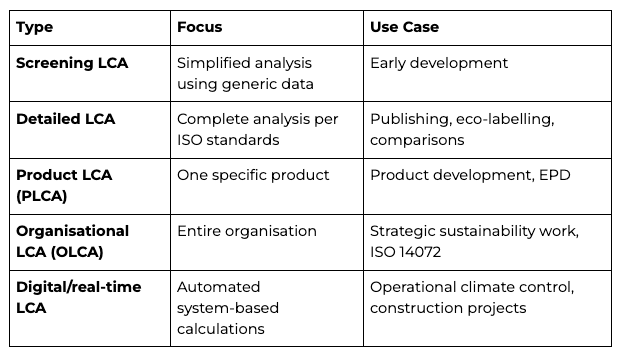
Guide to Different Types of LCAs
What Is the Difference Between an LCA and a Climate Calculation?
A climate calculation focuses on emissions of greenhouse gases expressed in CO₂e. It calculates climate impact – but not other environmental impacts.
An LCA goes further. It includes multiple types of environmental pressures: resource use, water consumption, and emissions to air, soil, and water across the entire life cycle (4,5).
A climate calculation can be part of an LCA but never the other way around.
For companies wanting long-term, strategic sustainability work, LCA provides a more complete foundation, highlighting environmental hotspots and guiding effective actions.
How to Get Started With an LCA
Conducting an LCA may seem comprehensive, but the process can be broken into clear steps:
- Define the scope
Establish the purpose, system boundaries, and what is included/excluded. - Collect data
Gather information on materials, energy use, transport, lifespan, and end-of-life. - Calculate
Use LCA tools or collaborate with an LCA consultant. Ensure calculations cover the full life cycle. - Analyse results
Identify hotspots such as resource-intensive materials or energy-heavy processes. - Communicate the findings
Use the results in sustainability reporting, product development, or customer communication. Transparency builds trust.
Start simple: a screening LCA can be done relatively quickly and provides valuable insights.
The Future of LCA
LCA is becoming a requirement rather than an option. EU regulations such as the Green Claims Directive and digital product passports, will require companies to demonstrate calculated environmental impacts.
Meanwhile, new tools are emerging: automated LCA systems, industry databases, and AI-assisted analyses.
Summary - Q&A
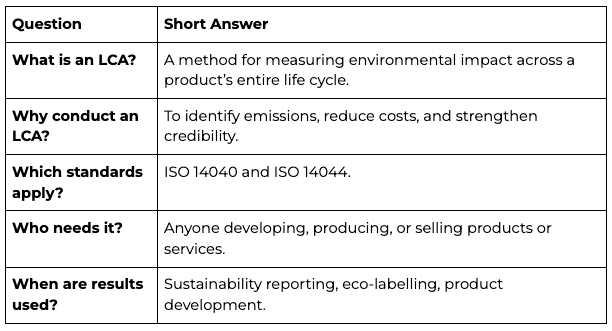
Summary
A Life Cycle Assessment (LCA) is a method used to analyse the environmental impact of a product, service, or process throughout its entire life cycle – from raw materials and material choices, through manufacturing, transport, and use, to recycling or disposal. By mapping energy use, water consumption, materials, emissions, and waste, an LCA reveals where the greatest impacts occur – the so-called “hotspots.” This holistic understanding helps companies make informed decisions and develop credible sustainability strategies and reporting.
Do you need transparent, quality-assured sustainability data for customers, investors, or upcoming EU requirements?
With GoClimate’s automated climate calculations, you get accurate figures from the start — allowing you to focus on the actions that truly matter. Get in touch and we’ll tell you more.
Sources
- 1. ISO – ISO 14040:2006 – Life cycle assessment — Principles and framework
- 2. Ecochain – Life Cycle Assessment (LCA) – Everything you need to know
- 3. Root Sustainability – Understanding ISO 14040 and 14044 Standards for LCA
- 4. European Environment Agency – Life-cycle assessment (LCA)
- 5. RIVM – What is LCA? – Life cycle assessment (LCA)
Want to go from knowledge to action?
See how GoClimate turns your accounting into a report you can act on.