Scope 1, 2 and 3: What's included?
Scope 1, 2 and 3 are the three categories that greenhouse gas emissions are divided into under the GHG Protocol, the global standard for climate reporting.

Put simply: Scope 1 is the emissions a company produces directly, Scope 2 is the emissions from the energy it uses, and Scope 3 is everything else linked to its operations, from the goods it buys to how customers use what it sells.
Here we go through exactly what's included in each scope, with concrete examples.
Want to skip the calculations? Book a demo with GoClimate.
Scope 1: Direct emissions
Scope 1 covers direct emissions, meaning emissions from sources a company owns or controls itself. Think of the exhaust from the cars in the company's own fleet, provided they run on fossil fuels rather than electricity.
What counts as Scope 1 emissions?
The most common examples are:
- Burning fossil fuels in your own vehicles, for example a fleet running on petrol or diesel (known as mobile combustion)
- Heating your own premises and facilities with oil or natural gas (known as stationary combustion)
- Industrial processes that release greenhouse gases directly, for example manufacturing or chemical handling
- Refrigerants leaking from air conditioning or cooling units, known as fluorinated gases (F-gases)
For many service companies and office-based businesses, Scope 1 emissions are limited, perhaps just a leased car fleet. For manufacturing and transport companies, they can instead make up a significant share of the total carbon footprint.
How do you calculate Scope 1?
The calculation is usually based on actual fuel consumption multiplied by emission factors, standardised values for how much carbon dioxide equivalent (CO₂e) is generated per unit of fuel. The Swedish Environmental Protection Agency (Naturvårdsverket) publishes emission factors for direct combustion emissions in Sweden, updated annually [1]. The IPCC provides default values (Tier 1), used mainly as a fallback when national data is missing [2].
Scope 2: Indirect emissions from purchased energy
Scope 2 is about emissions from producing the energy a company uses. They don't come from the business itself, but from the facilities that generate the energy. The classic example is the power plant that produces electricity for an office. Besides electricity, it also includes district heating, district cooling and steam bought from external suppliers.
Two ways to calculate: location-based and market-based
Calculating Scope 2 sounds simple: purchased energy multiplied by an emission factor. But there are two different methods, and the choice affects the result considerably.
The market-based method takes into account whether the company has agreements for renewable electricity, for example through guarantees of origin (GO certificates). If you buy certified hydro or wind power, your Scope 2 can be reported as zero, even though you're physically connected to the same grid as everyone else.
The location-based method instead uses the average emissions of the grid you're connected to, regardless of which electricity you've actually bought. The Swedish electricity mix is generally low in emissions thanks to a large share of hydro and nuclear power, but this varies between countries and grids.
Dual reporting is a requirement, not a recommendation
Since 2015, the GHG Protocol's Scope 2 Guidance has required both methods to be reported, for organisations with operations in markets where supplier-specific emission factors are available [3]. The CSRD and ESRS E1 have built in the same requirement for the companies covered by the directive, and the requirement remains even after the 2026 simplification of the ESRS [4]. So it applies today, not as a future requirement. It's also important to state clearly which method is used, otherwise figures from different companies can't be compared.
Scope 3: All other indirect emissions
Scope 3 covers emissions from everything else linked to the business: the production of what the company buys from others, and the use and end-of-life handling of its own products. If a company buys goods from a supplier, the emissions from manufacturing them count as Scope 3. It's the whole picture of the company's impact, from start to finish, across the entire value chain.
Scope 3 is often by far the biggest source of a company's climate impact. According to Carbon Trust, these indirect emissions can make up as much as 70–90% of a company's total carbon footprint [7]. Under the GHG Protocol, Scope 3 is divided into 15 categories, split between upstream and downstream emissions [5].
Upstream emissions (categories 1–8)
These are emissions in the supply chain before raw materials or services reach the reporting company. Common examples:
- Purchased goods and services: emissions from suppliers' production of what you buy
- Business travel, such as flights, trains and hotels for employees
- Commuting to and from work
- Capital goods such as machinery, vehicles and equipment
- Waste generated in your own operations and handled by external parties (category 5: Waste generated in operations) [6]
Downstream emissions (categories 9–15)
These are emissions after the company has delivered its product or service to the customer. Common examples:
- Transport and storage of sold products
- Emissions when customers use what you sell
- Treatment and disposal of sold products after use (category 12: End-of-life treatment of sold products) [6]
Why is Scope 3 the hardest to measure?
It requires data from parties outside your own operations, such as suppliers, customers and carriers. Many don't share emissions data, which means you often have to use industry averages and default values.
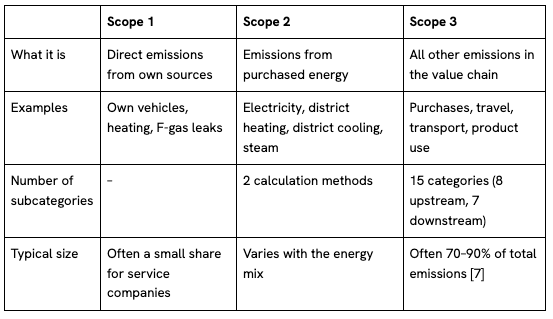
Summary: what's included in each scope
Calculate your Scope 1, 2 and 3 completely automatically
GoClimate automatically collects data from your invoices and receipts and turns it into a finished emissions calculation, including Scope 1, 2 and 3.
Sources
- Naturvårdsverket (Swedish Environmental Protection Agency): Calculating direct emissions from combustion
- Naturvårdsverket: Calculation according to the GHG Protocol or ISO standard
- GHG Protocol: Scope 2 Guidance (2015)
- EUR-Lex: Commission Delegated Regulation (EU) 2023/2772 (ESRS E1)
- GHG Protocol: Corporate Value Chain (Scope 3) Standard
- GHG Protocol: Technical Guidance, Category 5 (Waste generated in operations)
Want to go from knowledge to action?
See how GoClimate turns your accounting into a report you can act on.